

RSU Tax in India: ITR Reporting Guide
Learn how RSUs from foreign companies are taxed, how to report them in ITR Schedule FA, and how to avoid penalties under the Black Money Act.
- Did you know? Thousands of Indian professionals working for foreign tech giants receive Restricted Stock Units (RSUs) every year, but a shocking number fail to report them properly in their Income Tax Returns (ITR). This oversight could lead to penalties under the Black Money (Undisclosed Foreign Income and Assets) and Imposition of Tax Act, 2015, even if you’ve never sold a single share.
- If you're an Indian resident receiving RSUs from a U.S. or other foreign employer, this blog is for you.
- What are RSUs?
- Restricted Stock Units (RSUs) are company shares granted to employees as part of their compensation, but they vest over time, meaning you earn full ownership gradually, typically based on your tenure.
- How RSUs differ from salary:
- While salary is paid out monthly, RSUs are a form of deferred compensation. They are not taxed when granted but are taxed as income when they vest.
- The Vesting Process and Tax Implications:
- What is vesting?
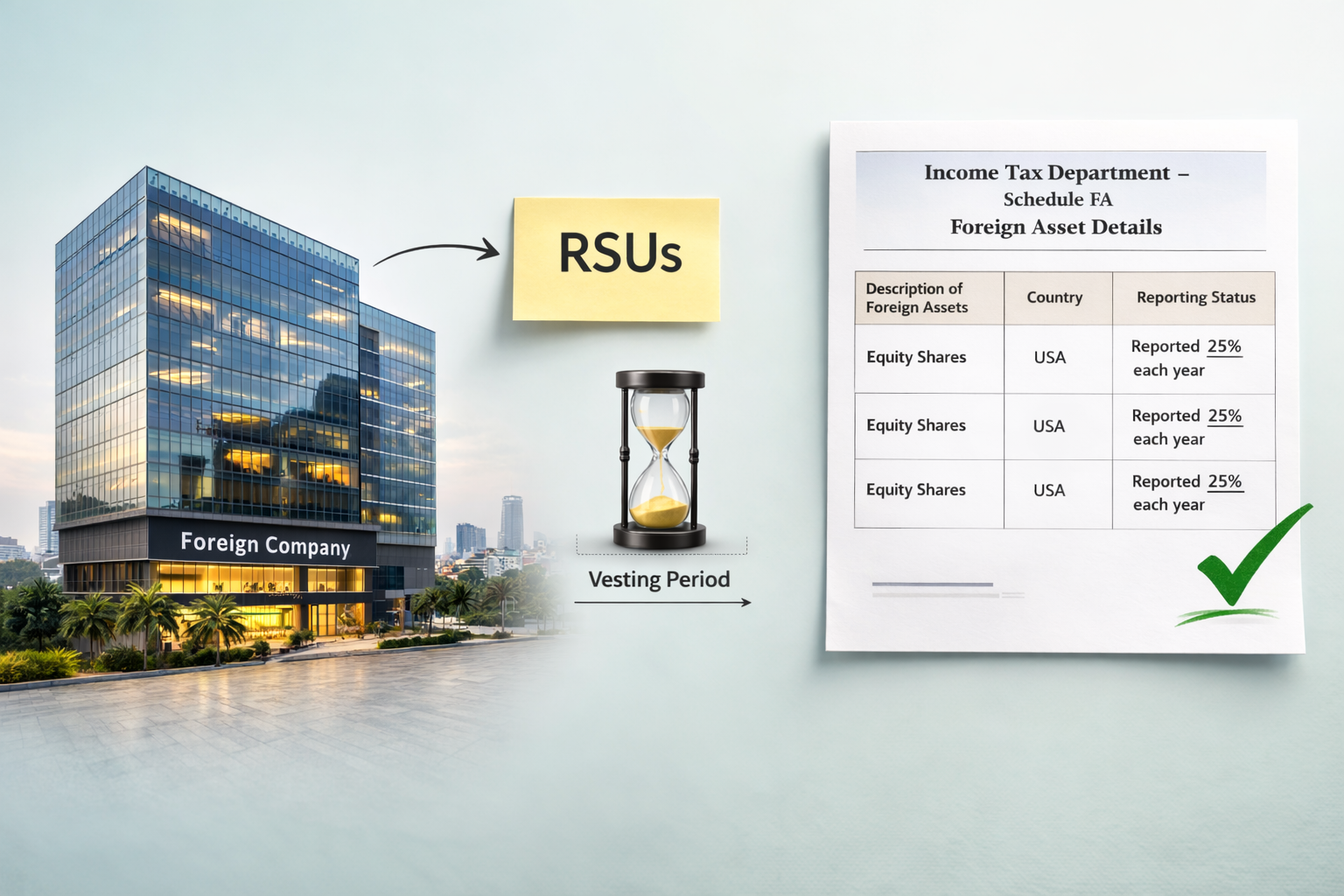
- Your RSUs don’t belong to you until they vest, typically over a 3 to 4 year period, often with a 25% vesting each year.
- How tax is deducted:
- On vesting, the gross value of shares (based on market price) is treated as income. Your employer usually deducts TDS (Tax Deducted at Source) or sometimes called as withholding tax and deposits it with Indian tax authorities.
- Broker account credit:
- After tax is deducted, the net shares are credited to your broker account.
- For example: You are Granted: 100 shares, Vested in 1st year: 25 shares, Shares sold (as a part of tax): 7 shares, hence, Net credited: 18 shares
- So, even if you haven’t sold anything yourself, tax has already been paid on the full value of those 25 shares.
- Form 16 and Indian Tax Treatment:
- RSU income is salary income under Indian tax laws - See Part B of your Form 16.
- Tax has already been deducted and paid
- You don’t have to pay again—but you must report it properly in your ITR
- Where to report them in your ITR:
- The Foreign Assets Schedule (FA) in ITR-2 or ITR-3 is mandatory. Few things to keep in mind –
- Disclose broker account details (e.g., Charles Schwab, Morgan Stanley)
- Report balances as of December 31 of the calendar year
- Include all types of foreign holdings—vested RSUs, ESOPs, ESPPs, etc.
- Disclose your related foreign income like dividend or interest in Schedule FSI and TR
- File Form 67 to claim the foreign tax credit on your foreign income
- There is a guideline issued by the Income Tax department regarding the reporting of foreign assets and income. Please follow the link for the same.
- Enhancing Tax Transparency on Foreign Assets and Income.pdf
- Consequences of non-compliance:
- Penalty of ₹10 lakh per year of non-reporting, Risk of prosecution under the Black Money Act and chances of Scrutiny from tax authorities even years later.
- Filing your ITR correctly and completely is your legal responsibility. So, make sure that you are filing the correct ITR and it's been filed accurately.