Which ITR Form Should You File? A Simple guide for Indian Tax payers
Confused about which ITR form applies to you this tax season? Whether you're salaried, a freelancer, or running a small business - this guide breaks down all 7 ITR forms in simple words so you file right the first time.
By Khusbu Modi on May 04, 2026
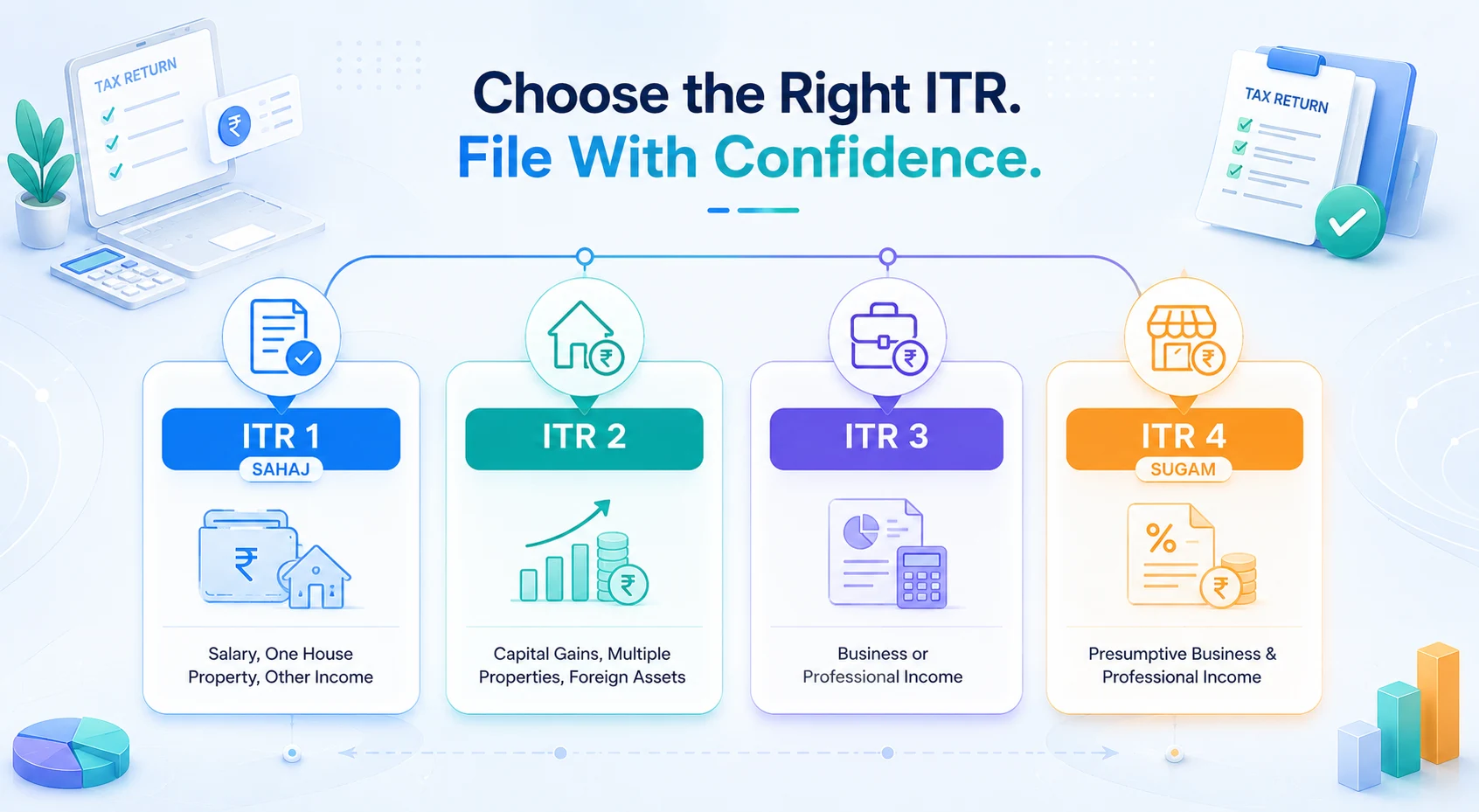
Which ITR to choose?
Filing your Income Tax Return for AY 2026–27 (FY 2025–26), now officially termed Tax Year 2025–26, begins with one critical decision: choosing the right ITR form. The correct form ensures a smooth filing process and shields you from rejections and scrutiny notices from the Income Tax Department. This comprehensive guide walks you through all seven ITR forms covering eligibility, key differences, and practical tips to help you file accurately and with confidence.
ITR-1 (Sahaj): Simplest for Salaried
Resident individuals with total income up to ₹50 lakh from salary, one house property (or none), and other sources like interest qualify for ITR-1.
Pre-filled using Form 16; no capital gains, foreign income, or agricultural income over ₹5,000 allowed.
Ideal for basic salaried employees - fastest e-filing option.
ITR-2: Multiple Income Streams
Individuals/HUFs with salary, multiple houses, capital gains (shares/property), foreign assets/income, crypto income (if capital gains)
Handles deductions (80C/80D), losses, and rentals; excludes presumptive business.
Common for investors or those with diverse non-business income.
ITR-3: Non-Presumptive Business
Individuals/HUFs with business/profession income (not presumptive), plus salary/house/capital gains/crypto income(as business income), file ITR-3.
Partners in firms (non-LLP) and proprietors prefer it.
ITR-4 (Sugam): Presumptive Taxation
Small businesses/freelancers under Sections 44AD/44ADA/44AE (turnover <₹2-3 crore), total income ≤₹50 lakh, plus salary/one house/other sources. Presumptive Income reporting.
Perfect for consultants, shopkeepers, or transporters.
ITR-5: Firms and Entities
Firms, LLPs, AOPs, BOIs, cooperatives, estates, business trusts file ITR-5 for business/capital gains incomes.
Includes partner details, audits if applicable; not for individuals.
Used by partnerships with complex structures.
ITR-6: Companies
Domestic/foreign companies (private/public/OPC) not claiming Section 11 exemptions use ITR-6.
Covers MAT, audits, business schedules; e-file audit reports first.
Essential for corporates and startups.
ITR-7: Exempt Organizations
Trusts (12A/12AB/10(23C)), political parties, hospitals, schools, or entities claiming Section 11/10/13 exemptions file ITR-7.
Needs Form 10B/10BB audits, donation reports (10BD); required even for nil income.
For NGOs and charities maintaining status.
Summary of ITR Selection
-
Form
Who Files
Income Limit
Key Features
Exclusions
ITR-1
Residents
(salary/one house)Pre-filled, simple
Capital gains, business, foreign
ITR-2
Individuals/HUFs
(no business)None
Gains, rentals, deductions
Business profits
ITR-3
Individuals/HUFs
(business non-presumptive)None
P&L, audit schedules
Presumptive only
ITR-4
Presumptive business/profession
≤₹50L
6-8% turnover profit
Complex gains, lottery
ITR-5
Firms/LLPs/AOPs
None
Partner details, entity incomes
Individuals
ITR-6
Companies
(non-exempt)None
MAT, corporate audits
Charities
ITR-7
Trusts/exempt institutions
None
Exemption audits, donations
How to Choose and File Without Errors
Use the Income Tax e-filing portal's 'Choose ITR' tool or flowchart to match your profile and start with income heads.
Deadlines: July 31 (non-audit individuals/business), August 31 (for ITR-3 and ITR-4), Oct/Nov 31 (audits),
Dec 31 (belated with fees).
Pre-validate with AIS/26AS/Form 16; e-verify via Aadhaar OTP/net banking within 30 days; retain proofs to avoid scrutiny.
Frequent Mistakes and Fixes
Wrong form triggers defective notices - salaried with RSUs/ESOPs jump to ITR-2, not ITR-1.
Overlook foreign assets (ITR-2/3) or presumptive eligibility (ITR-4).
Update for regime choice (old/new); refile if mismatched within deadlines.